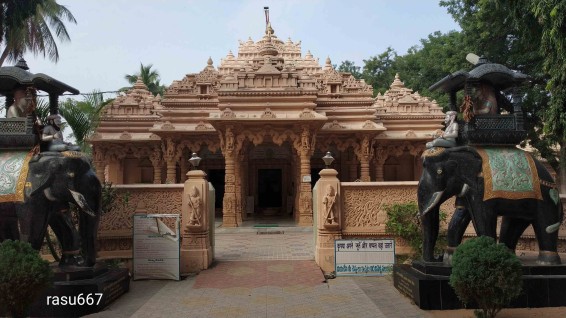
1000 pillar temple – Hanumakonda

Hanumakonda and Warangal are like twin cities, situated side by side. Hanumakonda was the capital of the Kakatiya dynasty before they shifted the capital to Warangal. In Hanumakonda we can see the famous Rudreshwara Temple, also famously known as the 1000 pillar temple, because it is made with 1000 pillars.

img_20200108_161515

The thousand pillar temple was built during the reign of Rudra Deva of the Kakatiya dynasty in 1163 CE in the style of later Chalukyan and early Kakatiyan Architechture.

img_20200108_161225

img_20200108_161249


The temple measures over 31*25 m and stands on a platform which is one meter above the ground. The temple is called 1000 pillar temple because of the pillars used for the temple. The entire wall of the temple is made up of pillars which are joined.

img_20200108_161344

It consists of three shrines to Shiva, Vishnu and Surya on three sides of the Rangamandapam. While Rudreshwara was having Nitya Pooja and was well illuminated, I am not too sure about Vishnu and Surya temples. One was locked, the other not too visible because of low lighting.

img_20200108_161540      img_20200108_161604

Black stone dwaram (doorway) to the garbagriha is richly sculpted. Photography is not allowed inside. But I requested the pujari to let me capture just the sculpture, because by then I was very sad seeing a lot of destruction in the Warangal fort and partly here too. Maybe he saw the love that I had for the art and sculpture, he allowed me to take pictures. I did not abuse his trust by taking pictures of Deva. Grateful that I was able to record this beauty.

img_20200108_161415

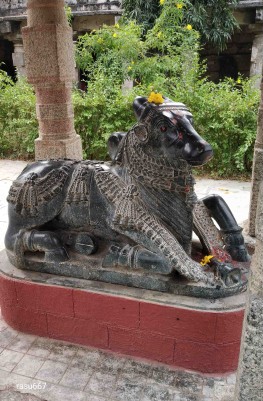
Coming to the massive Nandi in front of the temple, it is on an elevated plain pavilion. Richly ornamented it must have been glorious previously. Mark of invaders is very visible. Both ears are cut of, part of tail and left leg are broken. It breaks the heart to see such damage.

img_20200108_161448

A pillared Mandapam being reconstructed by the ASI. Because work is going on, couldn’t go there.


Thus ended the visit to another great ancient temple.

Warangal – Ruins of Swayambhu Shivalay

Warangal city is the district headquarters of Warangal Urban district of Telangana state. It is a city steeped with history. Previously known as Orugallu or Ekashila nagaram, which means a ‘single stone’ in telugu, it got its name by the huge boulder that lay in the Warangal fort. It was the capital city of the Kakatiya dynasty when they shifted their capital from Hanumakonda. Warangal is a three hour drive from Hyderabad and a must visit place for history and culture enthusiasts.

When I had planned a trip to Warangal, searching for places to see, I saw that Warangal fort is an important sightseeing place. So I was waiting to see a ruined fort. But when I went to the place called Warangal fort, I realised that it was that section of the fort where previously a Swayambhu Shivalayam existed and now had relics which were excavated.

img_20200111_154924

The Kakatiya thoranams

On four sides we can see the famous Kakatiya thoranams, one of which we can see in above picture. Smaller thoranams are also there. The Kakatiya Thoranam has been included in the emblem of the state of Telangana.

This area is the place where a Swayambhu Shivalay existed. The relics that have been excavated are displayed here.

img_20200110_210317  img_20200110_210432

img_20200110_210214

The beautiful sculpture by the Kakatiyas is on display, so is the destruction wrought upon them by the barbaric invaders. The Kakatiya rulers must have been great patrons of art and culture. Throughout Warangal, in the sculpture on the temples we can see dancers and musicians.

save_20200111_143237

img_20200110_212043

Even animals were not spared. Be it horses, elephants or lions. Their legs and heads were broken.

img_20200110_211531

A huge Kirtimukha gives us an idea of the scale of the temple. It must have been outstanding and majestic.

img_20200110_211955

A mandapam with Nandi. Again the sculpture has been destroyed.

img_20200110_210950

In such a scenario, any sculpture without destruction gives us great joy.img_20200110_212607

This partly broken elephant was used by children as a showpiece in a park and they were climbing it for pictures. I couldn’t keep quiet so told the teacher who came with them to not allow them to climb on top but to take pictures beside it and to not spoil our heritage.

img_20200111_155421         img_20200110_212919

Destruction and beauty side by side fills us with sorrow.

But we have to appreciate the talent of the sculptors of the Kakatiya period.


Kolanupaka

Almost 80 kms from Hyderabad lies the village of Kolanupaka in Aler mandal of Nalgonda district. The village is a must visit for heritage enthusiasts because we can visit an ancient Shiva and Jain temple.

Sri Someshwara temple

img_20200101_122837

Before we enter the temple complex, we can see a small shrine of Shiva with Nandi below the ground level. Few pieces from temples have been kept in such a way so that it doesn’t get filled with sand and mud. Sri Someshwara temple is under ASI.
img_20200101_123009
Shivalay below the ground level.
Entering the prakaram, we see a statue of a life sized Mahavira in a Padmasana. Behind is a stone Dwajastambam from ancient times. The present temple is 800-900 years old and built during the time of the Kalyani Chalukyas. It was also patronaged by the Kakatiyas.
img_20200101_132646            img_20200101_132814
In front of Dwajastambam is the standing statue of Hanumanji with Murti’s of Ganesha and Kartikeya on two sides. A little ahead is a small Mandapam with Nandi in it. This Nandi is well carved with ornaments.
Around this area is a prakara Mandapam which is used like a museum by ASI.
Some sculptures of various times are placed here. Some were found during a construction of a school and library in Kolanupaka. Sculptures from the 10th, 11th, 12th and 16th century can be found here. Some inscriptions of the Kalyani Chalukyas are also displayed.
img_20200101_123643    img_20200101_123821
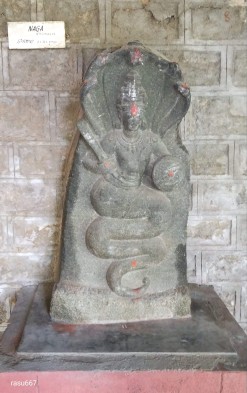
Parsvanatha                                                  Naga
At the entrance Mandapam some artifact’s are kept in a haphazard way. To the left there is an temple for Veerabhadra Swamy.
img_20200101_130313
Opposite to it is a temple of Shiva with Nandi in front.
img_20200101_130358
Doorway to the inner prakaram has carvings on three sides.
img_20200101_130859
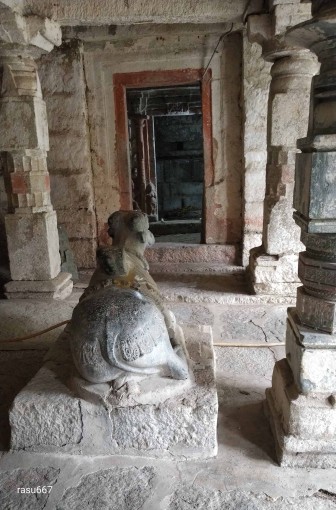
This Nandi and Shivalinga are in the Mandapam inside the temple. There is another lingam and paadams on another side. The garbagriha has a Swayambhu shivalingam and a Murti of Renukacharya behind it. It is said that Renukacharya was born from this shivalinga. He appeared on this earth to spread Veera Shaivism and after fulfilling his duty he is said to have joined with the lingam again. The Swayambhu lingam is said to be from Satyuga though the temple is 900 yrs old. Teachings of Renukacharya to Agastya rishi are recorded in ‘Sri Siddanta Shikamani’.
Beside the garbagriha is a temple for Sri Chandeeswari maata. Amma is said to be powerful and many people tie mudupulu to the top of the mandapam in front of her temple to ask for fulfillment of wishes.
img_20200101_131018
Coming out, we come to the temple of Kotilingeshwara swamy. The shivalinga is carved with miniature Lingas on it. There is a big Nandi in front of the garbagriha.
In this temple too I was happy seeing musicians entralling Deva with their music. A small tank  is there beside the main temple.
img_20200101_131453
At first I thought this structure was a Mandapam, but it is another Shivalay with Shivalinga and Nandi, but in bad shape.

img_20200101_131556

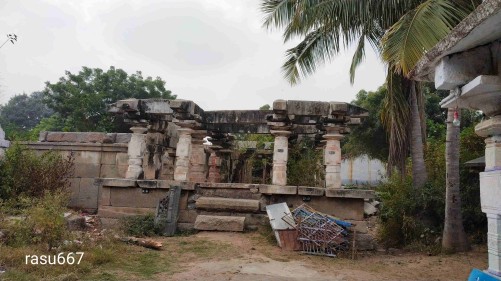
This structure is a ruined mandapam
It is easy to imagine how it must have been when it was built and many years later. The peaceful aura is not to be missed. Nor are the pieces of history kept all around.
Kulpakji Jain Mandir
img_20200101_180728
Kulpakji Jain Mandir is about 2000 yrs old. The present structure is a couple of decades old. It has murtis of Lord Rishabhanatha (carved in green stone), Lord Neminatha and Lord Mahavira.
Kolanupaka was a famous Jain center during Rashtrakuta times.
Photography is not allowed inside.
Kolanupaka was a place where Jainism thrived, before Veera Shaivism took over. Yet Jainism still flourishes over here.

Sri Rama Chandra Temple – Ammapalli

img_20191227_210251

Ammapalli is a village situated 30 kms from Hyderabad and 5 Kms from Shamshabad. In this small village lies the ancient Sri Ramachandra temple.

Built during the time of the Kalyani Chalukyas, it is between 800 to 900 years old. Though there are no stone inscriptions as to the date of the construction of the temple, the history has been told through generations and thus we know of its age. This temple has been used for many movie shootings and is believed to bring the movie success at the box office.

img_20191227_205922

The first look

When we approach the temple, we come towards the west side of it. We can see a Mandapam adjoining the prakara (compound wall). Going a little further, to the left we come across the temple tank or Pushkarini.

img_20191227_210112

Pushkarini.

Though it doesn’t have water in it now, we cannot fail to appreciate the beauty of it. It has a Prakara mandapam on 3 sides. The tank is surrounded by trees making the look so beautiful.

When we turn towards the temple, we can admire the 5 tiered Gopuram which is 90 feet high.

img_20191227_211522

Gopuram

The Gopuram which is 5 tiered surprisingly has a Rajasthani style of architechture in its first tier. There is a carving of Lord Vishnu on his Sheshtalpa on top of the Doorway. Once we enter the temple prakara (compound) we can see the Prakara mandapam (compound corridor) all around.

img_20191227_210536

Though there are some trees in the compound, what catches our eyes is the tree to the left that is said to be more than 300 years old and which has many bundles tied to it.

img_20191227_210505

These bundles are tied when a devotees prays for a specific wish and which will be removed when the wish is fulfilled.

img_20191227_210920

Vimana on the Garbagriha.

img_20191227_210752

A mandapam which has a stone Kurma (tortoise)

Going into the antarala, we go for the darshan of Lord Sri Rama, Sita Devi and Lakshmana. This place is believed to be a place where the three of them took rest during their aranyavasa (exile) hence only the 3 three murtis are there. As it was before the time they met Hanuman, his murti is not alongside Rama, Sita and Lakshmana. Here the Lord holds an arrow in his right hand and hence is called Kodanda Rama swamy. The murtis are made from ekasila (single stone) and are unique because they are carved with the makara toranam. While in all temples we have makara toranam above the deities in brass or silver, here they are carved within the same stone along with the murti. The Makara toranam of Lord Rama is unique because it has the dasavataras carved on it. It is said that once the devotees come for the darshan and ask anything with devotion, Sri Kodanda Rama fulfills it and the devotees come again to thank the lord.

img_20191227_211114

There are steps to go to the top of the prakara mandapam.

img_20191227_211340

We can see bench like structures on top which will enable people to sit and enjoy the peaceful atmosphere.

img_20191227_211215

View of the temple from the top of the prakara mandapam.

Coming out we can see another mandapam where previously marriages and the brahmotsavams of Rama took place.

img_20191227_211713

One movie whose picturization revolves around this temple is Murari. The story is woven around this temple and extensively shot here. Though it is a Rama temple, in the movie they showed it as a goddess temple. The movie was a huge hit and I am fond of it. Always I thought the temple shown in the movie was in a far off place,  I never imagined that it was so close to Hyderabad.

Outside there is an old Shiva temple and a smaller temple for Hanuman.

Was happy with the visit as I was able to enjoy the peaceful aura of the temple, have darshan of Deva and enjoy seeing the temple where the movie’s shooting took place.